Controlled evidence variations
Keep the task goal and rule fixed while varying the physical evidence that should change the next choice. Measure operation selection, physical execution, task completion and recovery separately.

Benchmarking the Reasoning–Action Connection in Robotic Laboratories
Observed outcomes guide the next operation. Measure choice, physical execution and task completion separately, then diagnose bottlenecks through controlled evidence variations and matched Oracle-assisted continuations.








Realizing Embodied AI for Science requires robots to translate experimental goals into reliable physical procedures, reducing hazardous and repetitive human work while generating evidence for scientific discovery. Although language-based planning and learned manipulation provide complementary capabilities, their integration requires robots to adapt subsequent operations to actual execution outcomes. For example, an unsuccessful placement changes what must be done next, even when the experimental goal remains unchanged. Existing benchmarks assess planning, manipulation, and laboratory workflows through task completion and reasoning or execution metrics; however, aggregate performance leaves the connection between outcome-dependent choices and physical execution unresolved. To address this evaluation gap, we introduce Labference, a benchmark for evaluating how observed physical outcomes guide subsequent choices and how those choices translate into robotic laboratory actions. Its evaluation protocol is designed to test outcome-dependent behavioral adaptation through controlled evidence variations, while independently measuring operation selection, physical execution, and task completion. Matched Oracle-assisted continuations from shared checkpoints then assess which forms of support improve subsequent choices and task completion. Initial weighing evaluations reveal target-selection errors in the tested VLA policies despite successful object transfers, whereas GPT-driven control achieves correct selection but encounters execution failures and substantial computation costs. Together, these findings highlight the need to connect task-appropriate reasoning with reliable, timely action. By making this connection measurable and diagnosable, Labference supports targeted improvements toward autonomous experimentation for Embodied AI for Science.
Outcome-grounded evaluation
Keep the task goal and rule fixed while varying the physical evidence that should change the next choice. Measure operation selection, physical execution, task completion and recovery separately.
Resume from shared physical checkpoints with scoped state, decision, geometry or execution support. Compare subsequent choices and completion to identify which support helps.
The report’s initial experiments concern feedback weighing. Fine-tuned VLA policies show target-selection errors despite successful transfers; GPT-driven control selects correctly but still encounters execution failures and substantial computation costs. These findings do not establish results across every task.
Selected laboratory workflows
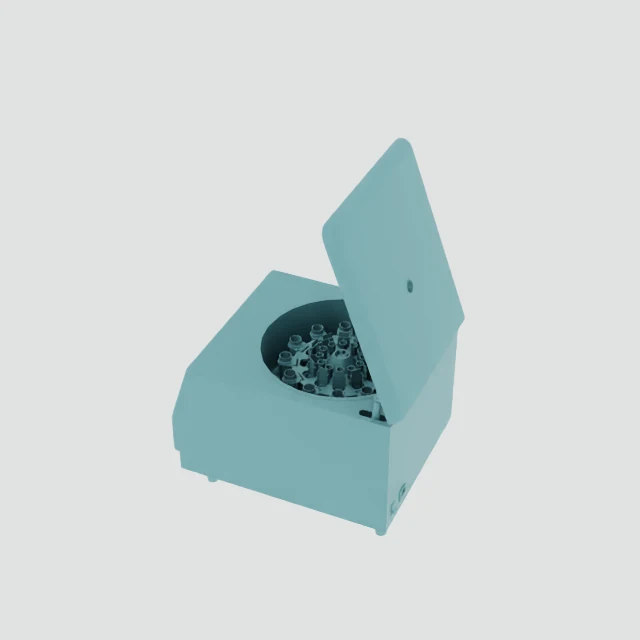
The report develops centrifuge loading, feedback weighing and placement recall in detail. Device operation is an additional selected workflow from the broader L01–L12 and R01–R12 catalogue. Explore successful main-camera collection demos for weighing and device operation, and simulator scene previews for centrifuge loading and rack recall.
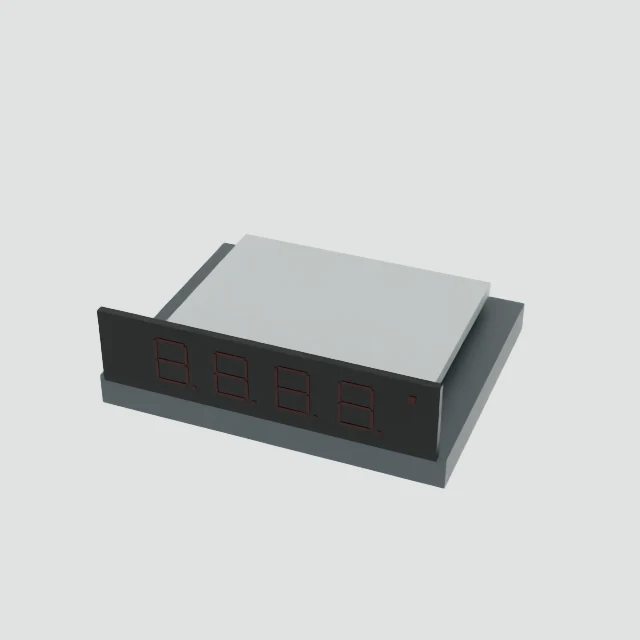
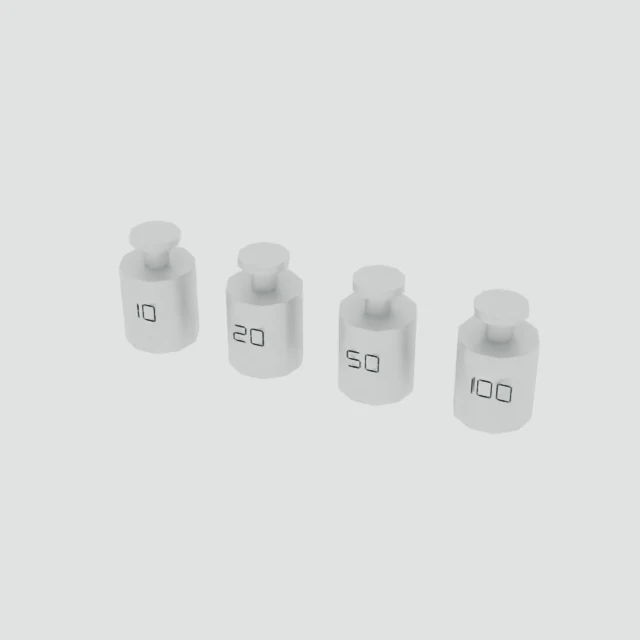
Correct an initially supported weight subset through live load-cell feedback until the exact target subset is stable.
Verified successful collection · Main camera · 10 Hz
View task details →Open the oven, load a loose beaker, close and reopen the door, retrieve it and return it while preserving the preloaded beaker.
Verified successful collection · Main camera · 10 Hz
View task details →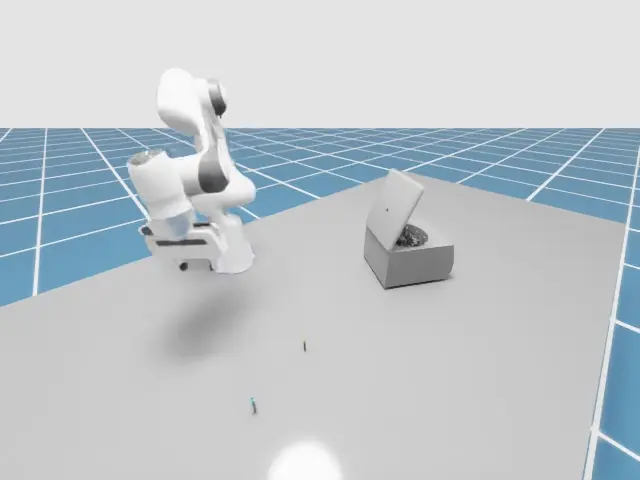
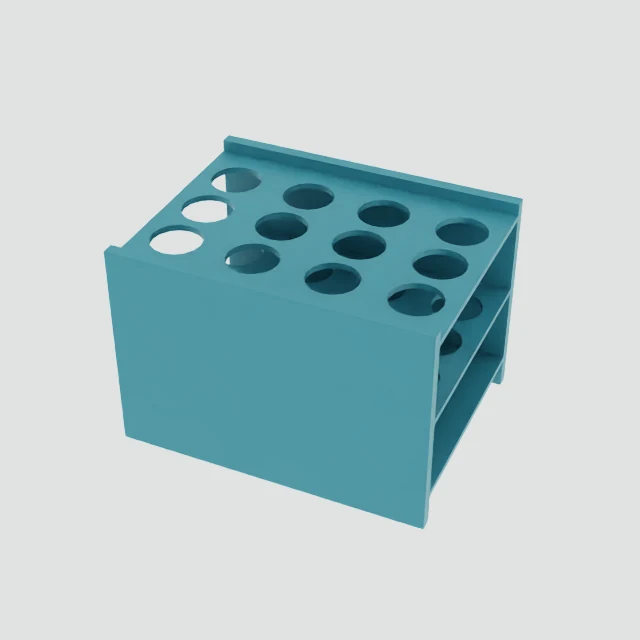
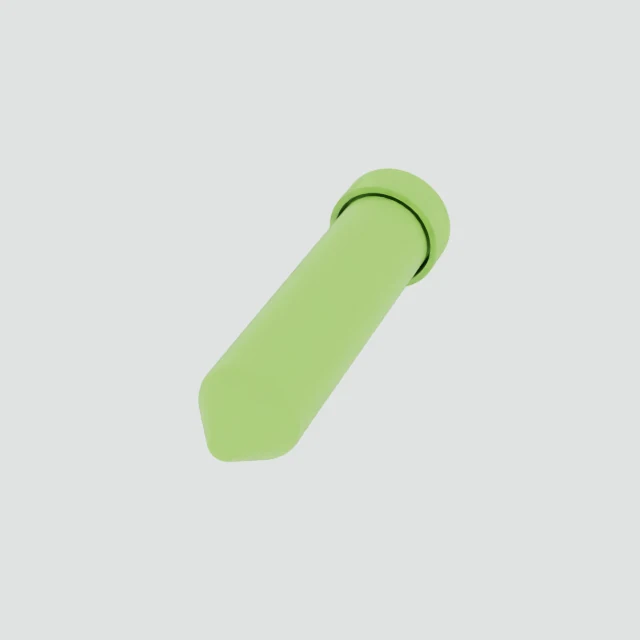
Pick both tubes from the table and place them in measured opposite slots with verified lift, insertion and stability evidence.
View task details →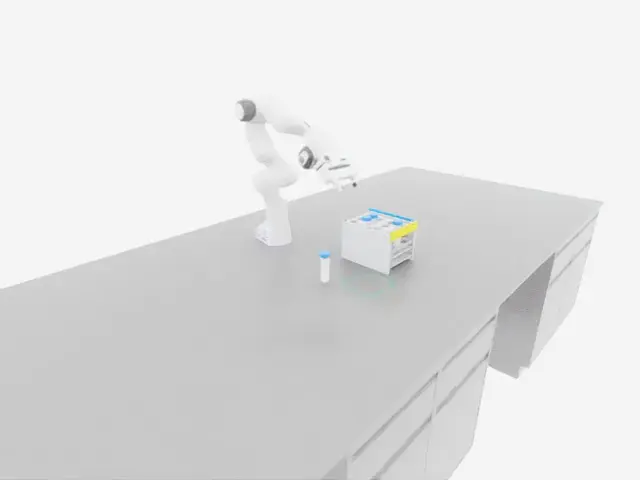
Remember a target slot when three distractor tubes share the same cap appearance and the rack moves during occlusion.
View task details →Featured task evaluation
Feedback weighing, device operation, centrifuge loading and rack placement recall each contribute 25% to the final success-rate score. Incomplete runs remain unranked.
No eligible model results published. Collection demos are not model scores.
Ordinary tasks remain available for optional evaluation; their scores are not published on this website.
Reproducible collection
Appendix A describes 24 tasks: twelve laboratory workflows (L01–L12) and twelve reasoning-in-action tasks (R01–R12). Their task cards and videos live on the Tasks page.
Explore 24 ordinary tasks →Real simulator geometry


@techreport{labference2026,
  title={Labference: Benchmarking the Reasoning--Action Connection in Robotic Laboratories},
  author={ Shitong Liu and Jingwei Zhang and Sheng Lian and Xinyu Zhuang and Kaiwen Guo and Quan Liu and Chunhai Zhao and Jiaxin He and Fan Yang and Manli Tao and Tingyu Yuan and Jinqiao Wang and Xiaojing Liu and Chaomin Guo and Feichan Yang and Hongwei Shi and Zhuang Xiong and Chaoyang Zhao and Zhiyong Liu },
  year={2026},
  type={Technical Report},
  month={October},
  note={Version 1, October 21, 2026}
}
Technical Report · October 21, 2026. Archival identifiers will be added when available.